App Analytics
Part of Mobile referral programmes
Measuring referred users by activation and retention
Define a referred-user cohort, calculate activation and useful return rates, and compare outcomes without confusing installs or causation.
Measure referred users by whether they complete a defined useful action and whether they later use the app when another need arises. Fix the accepted-referral group, identity rule, actions and windows before comparing cohorts. Share and install counts cannot answer either outcome question.
Define the referral cohort
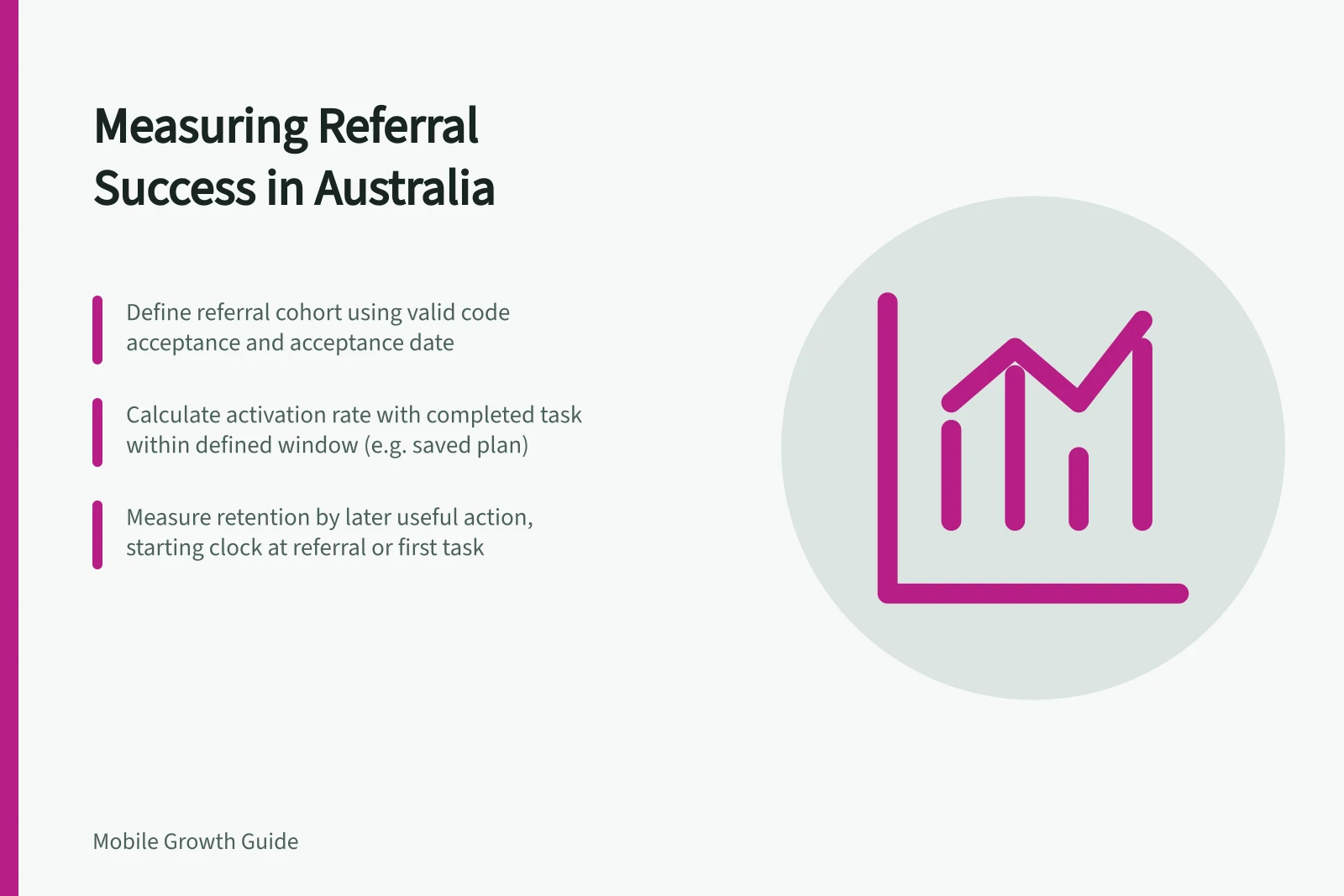
Choose the event that admits someone to the analysis, such as an eligible new account accepting a valid referral code. Record the acceptance date, identity rule, app version and relevant service area. A link open belongs in an earlier invitation-stage count until eligibility and referral acceptance are established.
Decide how existing customers, reinstalls and multiple devices are handled. Keep the referral association recorded at acceptance under the stated attribution rule. If a code is missing or competing claims cannot be resolved, label the source unresolved rather than assigning a referrer from later behaviour.
Calculate activation from a mature cohort
Use a completed action tied to the invitation's promise. In a hypothetical planning app, a plan saved successfully and available to reopen could count; opening the editor would not. Let E be the distinct eligible accepted-referral members whose full activation window has elapsed. Let A be members of that same E group who completed the action within the window.
Referral activation rate = A ÷ E.
Show both counts and the window. Keep recent members whose window remains open in a pending group, outside both A and E. If the completion event changes across app versions, mark the reporting break. A launch event is not the same as activation; a task-specific completion event must be defined and verified separately.
Key Metrics for Referred User Analysis
- Eligible Accepted Referrals (E)
- Distinct users who accepted referral with full activation window elapsed
- Activated Users (A)
- Users from E who completed defined useful action within window
- Referral Activation Rate
- A ÷ E
Measure a useful return
Choose a later useful action and a window that fits the task. State whether the return clock begins at referral acceptance or at the first completed task. In the planning example, reopening a saved plan when needed may be more informative than opening the app the next day.
For retention among all accepted referrals, use eligible accepted members with a fully elapsed return window as the denominator. Count those same members once if they complete the later action in that window, including the possibility that some never activated.
For retention among activated referrals, restrict both numerator and denominator to activated members with a fully elapsed return window measured from the stated start. Label the two rates separately: the second cannot describe everyone who accepted a referral.
Define an inclusion event and a return event for the cohort analysis, and check how the tool builds cohorts and periods. If the referral decision needs account-level identity across devices or exact elapsed-time windows, use an analysis that supports those rules instead of relabelling a cohort cell.
Compare without claiming causation
Place referred and other eligible new-user cohorts side by side only when their starting events, identity units, markets, task definitions and observation windows are compatible. Show cohort sizes and pending members. Compare activation and later use separately; a referral program may bring many first-task completions but few useful returns.
The groups may differ in intent, familiarity and the messages they saw. A rate difference is an association, not proof that referral caused better retention. Use the comparison to investigate the invitation promise, eligibility, first-task friction or the route back to a result. Preserve the cohort definitions with the decision.
Referral Activation vs. Useful Return Rates
- Activation Rate (Referral Cohort)
- A ÷ E
- Useful Return Rate (All Accepted Referrals)
- Return completions ÷ Total eligible accepted referrals with elapsed window
- Useful Return Rate (Activated Referrals Only)
- Return completions ÷ Activated members with elapsed window